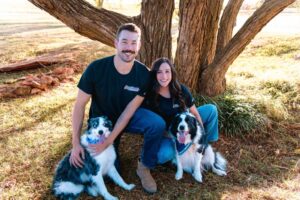
I’ve been running with my dogs for a long time. Rory, my border collie and Australian shepherd mix, has been my running partner for 11 years. Dexter, my border collie, has run beside me for 9. Between the two of them, that’s 20 years of miles — and some of the best training conversations I’ve ever had with a dog happened on a run.
Running is also part of how I train. The board and train dogs who come through our program go on structured runs too, because a dog who has burned off energy in a focused, purposeful way comes home calmer, more settled, and more ready to learn.
If you’ve ever thought about lacing up and taking your dog with you, this is the guide I wish every San Antonio dog owner had before that first run.
Is Your Dog Ready to Run?
Not every dog is ready to run on day one, and that’s okay. Before you start, run through this quick checklist:
Age matters. Puppies’ joints and growth plates are still developing, so structured running should generally wait until a dog is around 12 to 18 months old, depending on breed and size — bigger dogs usually need longer. Walking, play, and short bursts of free running in the yard are great for a puppy. A steady three-mile jog is not.
Get a vet check first. If your dog is new to exercise, overweight, a senior, or a flat-faced breed (bulldogs, pugs, and similar), check with your vet before starting a running program. A quick visit now saves you a problem later.
Breed and build play a role. Herding dogs, sporting dogs, and most medium-to-large mixed breeds tend to love running. Short-legged dogs, very heavy dogs, and flat-faced breeds often don’t — and that’s fine. Every dog has a job they enjoy. Running just might not be this one’s.
Can your dog walk nicely first? This is the one people skip, and it’s the most important. If your dog pulls on a regular walk, they will pull harder when you run. A dog who can heel and walk on a loose leash is ready to learn to run. A dog who drags you to every mailbox is not — yet. Start with leash manners first: our guide to teaching your dog basic commands is a good place to begin, and if the pulling is serious, our board and train program builds that foundation fast.
Teach No-Pull Running Before You Add Distance
The biggest mistake new running partners make is trying to teach running and leash manners at the same time, at speed. Don’t. Teach the position first, at a walk, then bring it up to a jog.
Start with heel. Your dog should run on one side — pick a side and keep it consistent — with their shoulder roughly at your hip. Practice at a walk until that position feels boring and automatic. Then add short jogging intervals: ten steps of running, back to a walk, praise and reward when they stay in position.
Use commands your dog already knows, or teach them now:
- “Heel” — stay at my side, in position.
- “Let’s go” — we’re moving forward together.
- “Wait” — stop and hold still (invaluable at street crossings).
- “Leave it” — ignore that squirrel, that smell, that other dog.
- “Cross” — switch sides on cue, so you can move your dog away from traffic, a cyclist, or another dog on a narrow trail.
Reward the position, not just the finish. In the early weeks, reward your dog often for staying in heel while you run — a treat every 30 seconds at first is not too much. You’re building a habit, and the goal is a dog who defaults to your side because that’s where the good stuff happens.
If your dog pulls, stop. Every time you keep running while your dog pulls, you’re teaching them that pulling works. Stop, reset, wait for slack in the leash, then go again. It’s tedious for about two weeks. Then it clicks.
The Gear That Actually Helps
You don’t need much, but the right gear makes a real difference — especially once you’re running regularly.
A hands-free waist belt and bungee line. This is the single best investment for running with a dog. A waist belt keeps your hands free and your center of gravity steady, and a bungee line absorbs the little tugs and jolts so a sudden stop doesn’t yank either of you. It turns running with a dog from a wrestling match into an actual run.
A well-fitting harness. For running, a harness beats a collar — it distributes pressure across your dog’s chest instead of their neck, which matters when they lunge after a rabbit at mile two. Look for a padded, Y-shaped harness that doesn’t restrict shoulder movement.
Water — for both of you. San Antonio runs are hot runs, even in November. Carry water for your dog, not just yourself. A collapsible bowl weighs nothing and fits in a belt pocket. Offer water at every stop, and watch for signs your dog needs a break: heavy panting that doesn’t ease up, lagging behind, or seeking shade.
Skip the retractable leash. On a run, you need a fixed-length line — about four to six feet — so you always know exactly where your dog is.
Build Up Gradually (Yes, Even for Your Dog)
Your dog needs a couch-to-5K plan just like you did. Start with a walk-run pattern: one minute of easy jogging, two minutes of walking, for about 20 minutes total, three times a week. Each week, lengthen the running intervals and shorten the walks.
A rough guide for a healthy adult dog who’s new to running: spend the first two weeks on walk-run intervals, then gradually lengthen the running stretches over the next month until you’re running steadily for about 30 minutes. That’s roughly a 5K, and it’s a great first goal.
Watch your dog, not the calendar. If they’re stiff or sore the next day, or they start lagging on runs they used to enjoy, you went too far. Back off and build again more slowly. And keep at least one rest day between runs at first — muscles and joints adapt on rest days, not run days.
This is also why running helps so many of our training dogs. A dog who has had structured exercise — a real job to do, a pace to hold, a handler to focus on — is a dog who can settle in the house afterward. The run burns energy; the focus builds impulse control.
San Antonio Heat Rules: Read This Before Your First Summer Run
This is the section that matters most, because Texas heat is the one thing that can turn a fun run into an emergency.
Run early or late — never midday. In San Antonio, that means before about 8 a.m. or after 7 p.m. in the warmer months. If you wouldn’t want to run in it, your dog definitely doesn’t.
Do the pavement test. Put the back of your hand on the pavement and hold it there for seven seconds. If it’s too hot for your hand, it’s too hot for your dog’s paws. Stick to grass and shaded trails instead, or wait for a cooler time.
Humidity counts as much as temperature. Dogs cool themselves by panting, and panting doesn’t work well in humid air. A 90-degree day with high humidity can be more dangerous than a 100-degree dry day. If the air feels thick and heavy, keep the run short — or skip it and do a training session inside instead.
Know the warning signs. Excessive drooling, heavy panting that doesn’t slow down when you stop, wobbling, or confusion are signs of overheating. Stop, get your dog into shade, offer water, and call your vet if things don’t improve quickly. Don’t wait it out.
Shorten summer runs, don’t skip them entirely. Most dogs can run year-round in San Antonio if you adjust — shorter distances, slower pace, earlier hours, more water breaks. Rory still runs with me at 11 years old, but our summer runs are shorter and slower than our winter ones. That flexibility is what keeps a senior dog running happily for years.
Where to Start Running in San Antonio
You don’t need a perfect trail — you need a flat, predictable surface where you and your dog can practice without too many surprises.
Leon Creek Greenway. This is my first recommendation for beginners. It’s flat, paved, shaded in stretches, and long enough for a short out-and-back without ever dealing with traffic. Go early in the morning and you’ll share it mostly with other runners and walkers. Keep your dog on leash and on your side — it’s a multi-use trail, and cyclists come through regularly, which is great practice for your “leave it” and heel work.
Eisenhower Park. The trails here give you a little more variety — dirt surfaces, gentle hills, and plenty of shade from the oak trees. The Hillview Trail is a good starter loop. It’s a little more rugged underfoot, so check paws afterward, and bring water — there isn’t much available on the trails themselves.
Your own neighborhood. Don’t overlook the simplest option. A quiet loop around your block at 6 a.m. is a perfect training run. Low distraction, familiar smells, and you can bail home in two minutes if your dog tells you they’ve had enough.
What Running With Your Dog Really Gives You
After 20 years of running with Rory and Dexter, I can tell you the real payoff isn’t fitness — although that’s nice too. It’s the partnership. A dog who runs with you learns to read your pace, your turns, your breathing, and you learn to read theirs. That teamwork carries over into everything else: obedience, confidence, and settling in a busy house or crowded park. For the dogs we train, it’s one more way to give them a job — and a dog with a job isn’t inventing their own entertainment, which usually means chewing your shoes or barking at the fence.
Start small. Be patient with the first two weeks. Pick a cool morning, grab your waist belt, and head to Leon Creek. Your dog will figure out the rest faster than you think.
Need Help Getting Your Dog Ready to Run?
If your dog pulls on leash, gets overexcited or reactive around other dogs, or can’t seem to settle even after exercise, that’s a training foundation issue — and it’s exactly what we fix every day. Our board and train program and obedience training build the heel, focus, and impulse control that make running with your dog actually enjoyable.
Call us for a free phone consultation — we’ll talk through your dog, your goals, and whether running together is the right next step. We’d love to help you and your dog find your stride.