
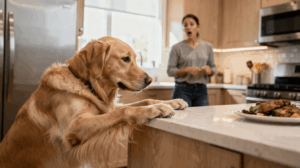
Counter surfing is also a safety issue. Dogs can reach foods that are toxic or harmful to them, as well as objects such as skewers, wrappers, sharp utensils, or hot cookware. The ASPCA’s list of foods to avoid feeding pets includes grapes, raisins, xylitol-containing products, onions, and garlic. If you believe your dog has eaten something potentially toxic, contact your veterinarian or an animal poison-control service promptly.
The most practical way to address counter surfing is a two-part approach. First, manage the environment so your dog cannot continue rewarding itself by finding food on the counter. Second, teach alternative behaviors such as “off,” “leave it,” and “place” so your dog has a clear and rewarding option instead.
This article focuses on practical household management and obedience skills that can help owners address counter surfing in real-life kitchen settings. Off Leash K9 Training of San Antonio offers obedience and Board & Train programs that include practical commands such as Off, Place, and distraction work.
Here’s what you’ll learn:
- Why dogs counter surf
- How to prevent successful food theft
- How to teach “off,” “leave it,” and “place”
- How to handle counter surfing when you are not watching
- What to do if your dog guards stolen food
- When professional dog training may be appropriate
Understanding Dog Counter Surfing
Counter surfing is usually a learned behavior reinforced by access to food or interesting objects. If a dog jumps up and discovers something rewarding, the experience can encourage the dog to try again.
The behavior does not require the owner to provide the reward. The food on the counter provides the reward itself, which is why counter surfing can become persistent even when the owner rarely gives the dog food intentionally.
Dogs may also investigate counters because of interesting smells, curiosity, previous success, or access to food left within reach. Any dog that can reach an elevated surface may learn the behavior.
Why One Successful Theft Matters
If your dog finds food on the counter once, that experience can make future checking worthwhile. This is why management matters so much.
The goal is not to teach your dog that counters are interesting but forbidden. The goal is to prevent the counter from continuing to provide rewards while you teach your dog a better behavior.
Best Friends Animal Society and the AKC both recommend managing access to counters and food so dogs cannot repeatedly reward themselves by stealing food.
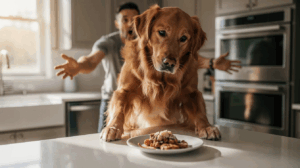
How to Stop Dog Counter Surfing With Management
Training is easier when the unwanted behavior is not being rehearsed every day.
Keep Counters Clear
The simplest management step is to remove food and other tempting objects from reachable surfaces.
Put food away promptly after cooking or serving. Clean crumbs, spills, grease, and food residue from counters. Do not leave cooling food, used plates, or snacks near the edge of a surface that your dog can reach.
Look beyond the main kitchen counter, too. Dining tables, coffee tables, chairs, stools, open bags, and accessible trash can all become sources of food or interesting objects.
Block Access When You Cannot Supervise
If your dog is not ready to ignore food reliably, prevent access to the kitchen or dining area when you cannot supervise.
Depending on your home and your dog’s behavior, this may mean:
- Using a secure baby gate
- Closing a kitchen door
- Keeping your dog in another safe area
- Using a crate if your dog is already comfortable with it
- Keeping tempting food completely out of reach
Management is not a replacement for training. It gives training a better chance to work because your dog is not continuing to practice the unwanted behavior.
Make the Kitchen Predictable
Everyone in the household should follow the same basic rules.
If one person leaves food on the counter while another person expects the dog to stay away, the dog continues to receive mixed opportunities. Consistency makes it easier for the dog to understand what behavior is expected.
For a deeper look at consistency and household rules, see our guide to consistent dog training.
Teach Your Dog What to Do Instead
Management prevents opportunities, but training teaches your dog how to respond when temptation is present.
Three useful skills are “off,” “leave it,” and “place.”
Teaching the “Off” Command
“Off” can teach your dog to remove its paws from a counter, table, furniture, or another elevated surface.
Start in an easy environment rather than beginning with the most tempting food on your kitchen counter.
If your dog places its paws on a safe training surface, calmly say “off” and use a treat to lure the dog back to the floor if needed. Mark and reward when all four paws are on the ground. Also reward your dog for keeping its paws on the floor before jumping occurs.
The goal is for the dog to learn that getting back onto the floor produces a better outcome than staying on the elevated surface.
Best Friends Animal Society’s guide to teaching “off” describes using a treat to guide the dog back to the floor, then marking and rewarding when all paws are on the ground.
Do not repeatedly yell “off” while your dog remains on the counter. If the dog does not understand the cue yet, make the exercise easier and teach the behavior through controlled repetitions.
Teaching “Leave It”
“Leave it” is useful when your dog notices food or another object that you do not want them to approach.
Start away from the kitchen with something relatively easy.
A simple progression is:
- Hold a low-value treat in a closed hand.
- Allow your dog to investigate.
- When the dog stops trying to get the treat, mark the desired response.
- Reward from your other hand.
- Gradually practice with the treat in an open hand.
- Increase difficulty only when your dog understands the behavior.
- Move to safe objects on the floor before practicing around more tempting situations.
The reward should come from you rather than from the item the dog was asked to leave.
Best Friends recommends starting “leave it” in a quiet setting and gradually increasing the difficulty before expecting the behavior to work around more tempting food.
Teaching a Reliable “Place” Behavior
“Place” gives your dog somewhere appropriate to be while you are preparing food.
Begin with a mat or dog bed in a quiet location.
Reward your dog for approaching the mat, stepping onto it, and eventually settling there. Once the behavior is becoming reliable, gradually add duration and mild distractions.
Then move the exercise closer to the kitchen.
You might practice while:
- Opening cabinets
- Moving around the kitchen
- Preparing simple food
- Opening the refrigerator
- Carrying an empty plate
- Performing other normal kitchen activities
The difficulty should increase gradually. If your dog repeatedly leaves the mat, make the exercise easier rather than simply repeating the cue.
The San Antonio dog obedience program currently includes Place and Off among its foundational commands, along with distraction work and practical real-world obedience.
For more information about impulse control, see our guide to canine impulse control.
Reward Four Paws on the Floor
You do not always need to wait for your dog to make a mistake before rewarding good behavior.
If your dog is standing calmly near the kitchen while food is being prepared, reward that choice.
You can reinforce:
- Staying on the floor
- Looking away from food
- Remaining on a mat
- Sitting calmly
- Responding to your cue
- Moving away from the counter
This teaches your dog that calm behavior around food can also produce rewards.
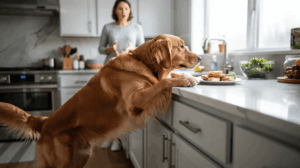
How to Train Around Real Kitchen Distractions
Once your dog understands the basic behavior, gradually make the environment more realistic.
Start with low distractions.
Then introduce one new challenge at a time:
- You standing near the counter
- Opening a cabinet
- Preparing food
- Carrying a plate
- Moving around the kitchen
- Having another person in the room
- Practicing during normal meal preparation
Your dog should remain supervised during this process.
Do not use a training session as a test of whether your dog can safely ignore unattended food. If you are leaving the room, remove the opportunity for counter surfing instead.
What If Your Dog Only Counter Surfs When You’re Gone?
This is a common management problem.
Your dog may have learned that the kitchen becomes an opportunity when nobody is there to interrupt the behavior.
The solution is not to punish the dog after you return. Instead:
- Clear the counters before leaving
- Block kitchen access when appropriate
- Secure trash
- Put food away
- Remove chairs or other obvious access points when necessary
- Give your dog an appropriate resting or enrichment area
A cue such as “place” cannot supervise an empty kitchen. Management remains important whenever you are not available to guide and reward the behavior.
What If My Dog Counter Surfs During Cooking?
Cooking can be one of the hardest times for a dog because food, movement, smells, and human activity all increase at once.
Before you start cooking:
- Clear unnecessary food from reachable surfaces.
- Decide where your dog will be.
- Give your dog an appropriate activity if needed.
- Ask for a known behavior such as Place.
- Reward calm behavior throughout the process.
- Use a gate or another safe management option if your dog cannot remain under control.
Do not wait until your dog has already stolen food before deciding how you will manage the kitchen.

Common Counter-Surfing Mistakes
Mistake 1: Leaving Food Out “Just for a Minute”
A short period of access is still an opportunity for reinforcement.
If you cannot supervise the dog, remove the food or prevent access.
Mistake 2: Repeating “No” Without Teaching an Alternative
Telling a dog what not to do does not automatically teach the dog what to do instead.
Pair management with behaviors such as Off, Leave It, and Place.
Mistake 3: Increasing Difficulty Too Quickly
A dog that understands Leave It in a quiet room may not immediately understand it when a steak is sitting on the counter.
Build difficulty gradually.
Mistake 4: Inconsistent Household Rules
If one family member feeds the dog from the kitchen counter while another tries to stop counter surfing, the behavior remains rewarding.
Everyone should follow the same basic rules.
Mistake 5: Testing the Dog Too Soon
Do not leave tempting food available simply to see whether your dog has learned the lesson.
Continue managing the environment while reliability develops.
What If My Dog Steals Food and Guards It?
Resource guarding is different from ordinary counter surfing.
If your dog grabs food and then freezes, stiffens, growls, shows teeth, snaps, or threatens when someone approaches, do not physically take the item away.
Give the dog space and seek professional guidance.
A dog that guards stolen food may need a behavior assessment rather than a basic counter-surfing lesson. If the stolen item may be toxic or dangerous, contact your veterinarian or an animal poison-control service promptly rather than attempting to solve the problem through physical confrontation.
When Should You Consider Professional Dog Training?
Professional training may be useful when:
- Your dog repeatedly ignores basic cues around food
- Counter surfing has become a long-established habit
- You cannot identify what is maintaining the behavior
- Your household needs a more structured training plan
- Your dog has additional obedience problems
- Counter surfing occurs alongside reactivity, aggression, or resource guarding
Off Leash K9 Training of San Antonio provides private obedience lessons and Board & Train programs. Its current obedience service includes foundational commands such as Place and Off, along with distraction work and owner education.
The Board & Train programs provide an immersive training format where dogs stay with a professional trainer and work on obedience, manners, and real-world distractions.
The appropriate training option depends on the dog’s age, behavior, training history, and goals.
How Long Does It Take to Stop Dog Counter Surfing?
There is no reliable universal timeline.
A dog that has counter surfed twice may progress differently from a dog that has been stealing food for months. Household consistency also matters.
The most important early goal is preventing successful thefts while you build the alternative behavior.
If your dog continues finding food on the counter, the behavior continues to receive reinforcement. If you consistently remove that opportunity while rewarding appropriate behavior, you give the new routine a better chance to become reliable.
Progress should be judged by the dog’s behavior and consistency rather than a fixed number of days or weeks.
Frequently Asked Questions
Why does my dog counter surf?
Dogs may counter surf because food or other interesting objects are accessible on elevated surfaces. Once the behavior results in something rewarding, the dog has a reason to try it again. Management and training should therefore work together.
Can you completely stop dog counter surfing?
Many dogs can make substantial progress with consistent management and training, but no responsible trainer should guarantee a specific behavioral outcome for every dog. Long-term success depends on the individual dog, household consistency, and continued management.
Should I punish my dog for counter surfing?
Punishment is not the best foundation for addressing counter surfing. Instead, prevent access to the reward and reinforce an appropriate alternative such as staying on the floor, going to Place, or responding to Leave It. AVSAB recommends reward-based methods for dog training and behavior modification.
What command is best for counter surfing?
“Off,” “Leave It,” and “Place” can all be useful, but they serve different purposes. Off can help your dog return to the floor, Leave It teaches the dog to disengage from an item, and Place gives the dog somewhere appropriate to settle.
Why does my dog only counter surf when I’m not home?
Your dog may have learned that food is accessible when nobody is present to interrupt the behavior. The answer is management: clear the counters and prevent access to the kitchen or other tempting areas when you cannot supervise.
Can puppies learn not to counter surf?
Yes. Early management can help prevent puppies from discovering that counters provide food rewards. Teach appropriate household behaviors from the beginning and supervise puppies around food and elevated surfaces.
What should I do if my dog steals food from the counter?
If the dog simply takes an item and is not guarding it, avoid turning the incident into a chase. Use a trained cue or safe exchange behavior when appropriate. If the dog freezes, growls, snaps, or guards the item, give the dog space and seek professional behavior guidance.
Is counter surfing dangerous?
It can be. Dogs may consume toxic foods or swallow dangerous objects. Hot cookware, sharp utensils, skewers, wrappers, and certain human foods can create safety risks. If your dog may have swallowed something dangerous, contact your veterinarian or an animal poison-control service promptly.
Related Resources
- Canine impulse control training
- How consistent training affects dog behavior
- Dog obedience training in San Antonio
- Board & Train programs
Conclusion
Dog counter surfing is usually easier to address when management and training are used together.
Start by removing food and other tempting items from reachable surfaces. Use gates, closed doors, or another appropriate management option when you cannot supervise. Then teach your dog what to do instead through behaviors such as Off, Leave It, and Place.
Build those behaviors in easy environments first and gradually add realistic kitchen distractions. Keep household rules consistent, and do not test your dog by leaving tempting food available before the behavior is reliable.
If counter surfing continues despite consistent management, or if it occurs alongside resource guarding or other serious behavior concerns, professional guidance can help you determine the most appropriate next step.
For professional obedience support in San Antonio, you can review the dog obedience training programs or contact Off Leash K9 Training of San Antonio to discuss your dog’s specific needs.