
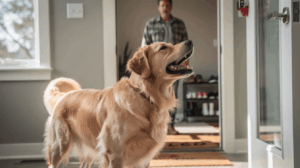
When your dog barks at the doorbell, the house can turn into instant pandemonium—loud, stressful, and difficult to manage when guests are waiting outside. Whether the sound means a package delivery, a visiting friend, or someone your dog has never met, the reaction can quickly become a familiar routine.
Barking at the doorbell can happen for several reasons, including alerting, excitement, frustration, fear, or a learned association between the sound and someone arriving. A useful training approach combines management with a clear alternative behavior, such as going to a designated place, while gradually helping the dog become more comfortable with the sound. Progress varies from dog to dog, so the goal should be steady improvement rather than a fixed timeline.
This article covers why dogs bark at the doorbell, immediate management strategies, step-by-step training, guidance for puppies and dogs with more challenging reactions, and when professional help may be appropriate. Dogs with serious aggression, bite histories, intense fear, or other complex behavior concerns may need an individualized plan rather than a basic home-training routine.
If you’re a San Antonio dog owner dealing with doorbell barking, this guide provides practical steps to help you get started safely.
By the end, you will understand:
- Why dogs may bark when the doorbell rings
- How to manage the situation while training is underway
- How to teach a Place behavior
- How to gradually introduce the doorbell sound
- How to practice with visitors
- What to do when barking occurs alongside fear or aggression
- When professional dog training may be appropriate
Understanding Why Your Dog Barks at the Doorbell
Before changing the behavior, it helps to consider what happens immediately before, during, and after the barking.
Doorbell barking may involve alert behavior, excitement, frustration, fear, or a combination of emotions. The sound may also have become a strong learned cue because it repeatedly predicts that someone is about to approach the home.
Your dog’s body language can provide useful information. Look at the entire picture rather than assuming the barking has one specific cause.
Territorial and Alert Barking
Some dogs become alert when they hear the doorbell because the sound predicts someone approaching the home.
Signs can include:
- Running toward the door
- Standing stiffly or leaning forward
- Repetitive barking
- Watching the entrance closely
- Remaining focused on the visitor
Barking can become persistent when the dog repeatedly experiences the same sequence: the doorbell rings, the dog rushes to the door, and the visitor eventually leaves. From the dog’s perspective, the behavior may continue because the pattern is repeatedly rehearsed.
Doorbell barking can occur in dogs of any breed or mix, and the motivation may differ from one dog to another.
Excitement and Frustration
Not every barking dog is trying to warn the household about a stranger.
Some dogs become excited because the doorbell predicts:
- Guests arriving
- Attention from new people
- Play
- A change in household activity
- Access to someone they want to greet
Frustration can also contribute when the dog wants to reach the visitor but cannot immediately do so.
An excited dog may have a loose, wiggly body, jump, spin, whine, or rush around the house rather than showing the stiff posture associated with some alert responses.
Anxiety and Fear
Some dogs bark at the doorbell because they are worried about the sound or the person who may appear afterward.
Signs can include:
- Backing away
- Crouching
- Hiding
- Trembling
- Avoiding the visitor
- Continuing to show stress after the visitor arrives
Past experiences, limited exposure, or a strong reaction to unfamiliar sounds may contribute to fear around the doorbell.
If fear is significant, training should prioritize safety and gradual exposure rather than forcing the dog to interact with visitors.
What Research Says About Dog Barks
A study published in Animal Behaviour found measurable differences between barks recorded during play, isolation, and a stranger ringing the doorbell. However, bark sounds should be interpreted alongside body language and context rather than treated as a diagnosis by themselves.
The practical takeaway is simple: pay attention to what your dog is doing, what happens immediately before the barking, and how quickly your dog can recover afterward.
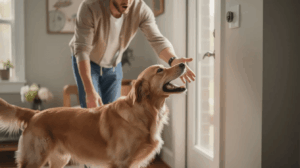
From Chaos to Calm: What Needs to Change
Effective doorbell training usually involves changing two things:
- How your dog responds to the sound
- What your dog does when the sound occurs
Yelling “quiet” from across the house does not tell your dog what behavior you want instead. It can also add more excitement to an already stimulating situation.
A better approach is to manage the environment while teaching a specific alternative behavior.
Change What the Doorbell Predicts
If the doorbell always predicts a stranger walking through the door, your dog may become excited or worried before anyone even enters.
VCA’s guidance on desensitization and counterconditioning explains how gradual exposure and positive associations can help address fear or anxiety. Begin with an easier version of the sound at an intensity your dog can comfortably handle, then pair it with something enjoyable.
The important part is the intensity of the exercise.
If your dog is already barking, lunging, hiding, or unable to respond to you, the setup may be too difficult.
Give Your Dog a Job
Telling a dog what not to do is only part of the solution.
Teaching an alternative behavior gives the dog something specific to perform when the doorbell rings.
Useful options include:
- Going to a mat or bed
- Sitting or lying down
- Remaining behind a secure gate
- Going to a crate or safe area
- Looking toward the owner instead of rushing the door
A Place behavior gives your dog a predictable destination away from the entrance. Best Friends Animal Society’s guide to teaching “go to your place” explains how to build the behavior before practicing with doorbell sounds and planned visitors.
Managing the Environment While Your Dog Learns
Management prevents your dog from repeatedly practicing the behavior while you build a new response.
You can start with simple changes:
- Put a note on the door asking expected visitors to text instead of ringing while training is underway.
- Use a secure gate, closed interior door, or leash when appropriate so the dog cannot rush the entrance.
- Keep rewards available so you can reinforce calm behavior quickly.
- Give your dog a comfortable area away from the entrance where they can settle.
- Use an appropriate enrichment item when it helps your dog remain calm and safely occupied.
During unexpected deliveries, management is more important than trying to turn the event into a training session.
Secure your dog first, then answer the door.
A delivery driver does not need to become part of your dog’s training exercise.
Preventing repeated full-intensity reactions while you train is consistent with current guidance on managing doorbell and visitor-related behavior.
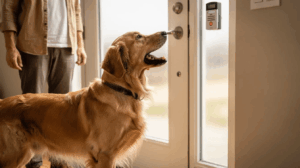
Step-by-Step Training: Teaching Calm Doorbell Manners
Doorbell training should begin with behaviors your dog already understands in an easy environment.
Move gradually and adjust the exercise if your dog becomes overwhelmed.
Phase 1: Build a Reliable Place Behavior
“Place” means your dog goes to a specific bed, mat, or designated area and remains there until released.
It can be useful for doorbell manners because it gives your dog a clear alternative to rushing toward the entrance.
The behavior should first be taught in a calm setting before it is connected to the doorbell.
Step 1: Choose the Location
Choose a comfortable mat, bed, or designated area several feet away from the front door.
The location should give your dog enough distance from the entrance to remain comfortable while you handle visitors.
Step 2: Reward the Behavior
Encourage your dog to step onto the mat and reward the behavior.
Once your dog willingly moves there, begin adding the verbal cue you want to use, such as “place” or “go to your mat.”
Step 3: Build Duration
Reward your dog for remaining on the mat.
Start with a short duration and gradually increase the amount of time your dog remains there.
If your dog repeatedly gets up, make the exercise easier instead of simply repeating the cue.
Step 4: Add Distance
Take one step away, return, and reward.
Gradually practice moving farther away while your dog remains in place.
You can eventually add small distractions such as walking toward the door, touching the doorknob, or moving around the room.
Phase 2: Introduce the Doorbell Sound
Once the Place behavior is comfortable, begin connecting it to the doorbell.
A recording of your actual doorbell can make this easier because you control the volume, timing, and number of repetitions.
Start With an Easy Version
Play the recording quietly enough that your dog can notice the sound without becoming highly reactive.
Reward calm behavior.
If your dog barks, rushes toward the door, hides, or becomes unable to respond, lower the difficulty.
You may need to:
- Reduce the volume
- Increase the distance from the speaker
- Use fewer repetitions
- Practice in another room
- Return to Place training without the sound
The goal is controlled learning, not simply exposing the dog to the sound until they stop reacting. Gradual desensitization works best when the dog remains able to cope with the stimulus.
Phase 3: Pair the Sound With Place
When your dog can calmly hear the recording, connect the two behaviors.
A simple sequence is:
- Play the doorbell sound.
- Give the Place cue.
- Guide your dog there if necessary.
- Reward the dog for getting onto the mat.
- Continue rewarding calm behavior.
- Release the dog when the exercise is complete.
With repetition, the goal is for the doorbell sound to cue movement toward the designated area. The AKC’s doorbell and door-knocking manners guide describes building this association through guided practice and rewards.
Phase 4: Add Your Movement
Once the sound and Place behavior are working separately, add your own movement.
You might:
- Stand up
- Walk toward the hallway
- Pick up your keys
- Touch the doorknob
- Walk partway toward the entrance
- Return to reward your dog
Do not change everything at once.
If your dog struggles when you stand up, practice that movement without the doorbell until it becomes easier.
Gradually increasing difficulty is an important part of helping dogs generalize a learned behavior.
Practice With Planned Visitors
Real visitors add several challenges at once:
- Doorbell sound
- Human movement
- Voices
- Door opening
- A person entering the home
- Possible greetings
- Increased household activity
That is why planned practice is useful.
Ask a friend or family member to help rather than using an unexpected visitor as the first test.
Start With the Dog Under Control
Keep the dog on a leash or behind a secure barrier when appropriate.
Ask the helper to ring the bell once.
Give your dog the Place cue and reward the desired response.
If your dog becomes highly reactive, stop and make the exercise easier.
Open the Door Gradually
Once the dog can handle the sound and your movement, add the door opening.
You can begin by:
- Walking toward the door
- Touching the handle
- Opening the door slightly
- Closing it
- Returning to reward the dog
- Gradually increasing the amount the door opens
Do not rush into a full greeting.
Introduce the Visitor
When the dog is ready, allow the helper to enter calmly.
The visitor should avoid immediately reaching toward or exciting the dog.
Depending on the dog’s behavior, the first few sessions may work best with the dog remaining on Place or behind a secure barrier.
Greeting is not required.
For dogs that become overwhelmed around visitors, remaining safely separated may be the better goal.
The AKC’s doorbell-training guidance recommends using a leash or secure gate when needed to prevent dogs from rushing through the entrance while door manners are being developed.
What If Your Dog Still Barks?
Some barking during the early stages does not mean training has failed.
Look at the entire response.
Ask:
- Did the dog recover faster?
- Did the dog respond to the Place cue?
- Did the dog stop rushing toward the door?
- Could the dog take a reward?
- Could the dog settle afterward?
- Was the dog less intense than during a real visitor arrival?
A dog that gives an alert bark and then moves away may be making meaningful progress even if complete silence has not been achieved.
The goal is a safer, more manageable response—not necessarily the elimination of every vocalization.
Common Doorbell Training Problems
Problem: Your Dog Sprints to the Door
Use management before the doorbell rings.
A secure gate, leash, or separate area can prevent your dog from rehearsing the rush.
Then practice the Place behavior away from the door before reconnecting it to the sound.
Problem: Your Dog Goes to Place but Keeps Barking
Reward short periods of calm behavior.
You may need to start with very brief moments of quiet before gradually increasing what you expect.
Avoid shouting over the barking.
If the dog is too aroused to respond, make the exercise easier.
Problem: Your Dog Is Calm During Practice but Reacts to Real Visitors
This usually means the training needs more gradual generalization.
A recording is only one part of the trigger.
Real visitors add:
- Footsteps
- Voices
- Door movement
- Your movement toward the entrance
- A person entering the home
Change one factor at a time rather than adding all of them together.
Problem: Your Dog Barks Before You Can Cue Place
Management becomes especially important here.
Keep the dog away from the entrance or use a barrier while you build the behavior.
Practice fake doorbell repetitions more often than you experience real visitors.
The goal is to give the dog enough controlled repetitions that the new response becomes familiar.
Problem: Your Dog Becomes More Frantic During Training
Stop increasing the difficulty.
Lower the volume, increase distance, remove the visitor, or return to an easier behavior.
If the dog cannot eat, cannot disengage, is hiding, trembling, repeatedly hitting the barrier, or remains highly distressed, the exercise is too difficult for a basic home-training session.
Multiple Dogs Barking at the Doorbell
Multiple-dog households can create an additional challenge because one dog’s reaction may influence another dog.
Start by training dogs individually.
Each dog can learn their own Place location and doorbell routine without another dog adding excitement.
Once each dog can perform the behavior separately, gradually practice them together.
Use separate designated areas if necessary.
Do not expect several dogs to learn the routine at the same time simply because one dog already understands it.
Dogs That Are Fearful, Reactive, or Aggressive With Visitors
Doorbell barking can sometimes be part of a larger behavior concern.
If your dog:
- Lunges at visitors
- Snaps
- Attempts to bite
- Growls intensely
- Cannot recover after the visitor leaves
- Hides or trembles from fear
- Redirects aggression toward family members
prioritize safety instead of continuing to increase the difficulty of home training.
Use appropriate barriers, closed doors, or other management strategies to keep visitors and dogs separated when necessary.
Do not force a fearful dog to greet someone.
Do not allow children to approach a dog that is growling, snapping, hiding, or showing other signs of distress.
If barking occurs alongside serious aggression or reactivity, professional behavior support may be appropriate. Off Leash K9 Training of San Antonio offers behavior modification options for dogs dealing with aggression and reactivity, with program recommendations based on the dog’s behavior, history, and safety needs.
Exercise and Mental Enrichment
Meeting your dog’s physical, mental, and behavioral needs can support better overall regulation, but there is no universal amount of exercise that will prevent doorbell barking.
Consider your dog’s:
- Age
- Health
- Breed
- Activity level
- Individual temperament
- Existing training
Appropriate walks, sniffing opportunities, play, enrichment, and short training sessions can all be useful parts of a balanced routine.
Mental work can also give your dog appropriate outlets for attention and engagement.
The important point is that exercise should complement doorbell training rather than replace it.
When Should You Consider Professional Dog Training?
Professional help may be useful when:
- Your dog repeatedly ignores basic cues around the door
- Doorbell barking has become a long-established routine
- You cannot determine what is triggering the response
- Your household needs a structured training plan
- Your dog has additional obedience problems
- Barking occurs alongside aggression or serious reactivity
- Your dog becomes highly fearful or distressed during training
Off Leash K9 Training of San Antonio offers private obedience training and Board & Train programs. Its current obedience service includes commands such as Place and Off along with distraction work, while the Board & Train service includes door manners, Place, Off, and real-world distraction training.
You can review the available dog obedience training options to compare training formats and determine what may fit your dog’s needs.
For dogs that need a more immersive format, review the available Board & Train programs.
How Long Does It Take to Stop Doorbell Barking?
There is no reliable universal timeline.
A dog that has recently developed the behavior may progress differently from a dog that has rehearsed the response for years.
Fear, excitement, household routines, training history, and the intensity of the trigger can all affect progress.
Rather than focusing on a specific number of days or weeks, watch for meaningful changes such as:
- Less intense barking
- Faster recovery
- Less rushing toward the door
- Better response to Place
- More ability to focus on the owner
- Greater comfort around visitors
If progress stalls, return to an easier training stage instead of simply adding more intensity.
When to Contact a Veterinarian or Behavior Professional
A sudden change in barking behavior can sometimes warrant veterinary attention, especially when it occurs alongside other changes in behavior, appetite, sleep, movement, or sensitivity.
Professional behavior support is also appropriate when your dog shows significant fear, aggression, bite risk, or difficulty recovering after visitors arrive.
A qualified professional can help determine whether the issue is primarily an obedience problem, an emotional response, or part of a broader behavior concern.
Frequently Asked Questions
How do I stop my dog from barking every time the doorbell rings?
Start by managing access to the entrance and teaching an alternative behavior such as Place. Practice the doorbell sound gradually at a level your dog can handle, reward calm responses, and slowly introduce more realistic distractions.
Why does my dog bark at the doorbell?
Dogs may bark because the sound triggers alert behavior, excitement, frustration, fear, or a learned association with someone arriving. Look at your dog’s body language and the surrounding situation instead of assuming every dog is reacting for the same reason.
Should I say “quiet” when my dog barks at the door?
You can teach a quiet cue, but yelling repeatedly is unlikely to solve the underlying problem. A clearer approach is to teach a replacement behavior and reinforce the dog when they respond appropriately.
Is it normal for a dog to bark when someone comes to the door?
Barking is normal dog communication, and some dogs naturally alert when someone approaches the home. The goal is to help your dog respond in a way that is manageable and safe for the household rather than assuming every bark needs to disappear completely.
Can I use a doorbell recording for training?
Yes. A recording can give you more control over the intensity and timing of practice. Start at a level your dog can handle and gradually increase difficulty. If the dog becomes highly reactive or fearful, make the exercise easier.
How do I teach my dog to go to Place when the doorbell rings?
First teach Place without the doorbell. Reward your dog for going to the designated mat or bed and remaining there. Once that behavior is reliable, introduce the doorbell sound at an easy level and connect the sound with the Place cue.
Why does my dog bark at the doorbell but not other sounds?
The doorbell may have a specific learned meaning because it predicts someone approaching the home. Your dog may be reacting to the entire sequence, including the sound, your movement toward the door, footsteps, voices, and the visitor entering.
Should I let my dog greet visitors after the doorbell rings?
Not necessarily. If your dog becomes overly excited or fearful, remaining separated behind a secure barrier may be safer. Greetings can be introduced later if the dog can remain calm and the interaction is appropriate.
What if my dog becomes aggressive when visitors arrive?
Prioritize safety and prevent direct access to visitors. Do not force the dog to interact or allow children to approach. If your dog lunges, snaps, bites, or shows serious aggression, seek professional behavior guidance for an individualized plan.
Can puppies learn better doorbell manners?
Yes. Puppies can begin learning household routines and alternative behaviors early. Start with simple skills such as going to a mat, responding to their owner, and remaining calm around everyday household sounds before gradually introducing the doorbell.
How can professional dog training help with doorbell barking?
Professional training can provide structured practice around obedience, Place, distraction work, and door manners. The appropriate format depends on the dog’s age, behavior, training history, and goals. San Antonio’s current obedience and Board & Train programs include several of these skills.
Conclusion and Next Steps
Barking at the doorbell can become a strong routine when the sound repeatedly predicts visitors, excitement, or unfamiliar activity.
Your dog is responding to a trigger, and the most practical approach is to manage the environment while teaching a clear alternative behavior.
Start by preventing uncontrolled rushes to the entrance. Then build a reliable Place behavior in a calm environment before gradually connecting it to the doorbell.
As your dog improves, add realistic distractions one at a time. Practice with planned visitors, keep safety in mind, and avoid testing an unfinished skill during a busy delivery or gathering.
If your dog’s response involves serious fear, aggression, or other safety concerns, professional guidance may be appropriate.
For San Antonio dog owners who want professional support, you can review the dog obedience training programs, explore Board & Train programs, or contact the training team to discuss your dog’s needs.